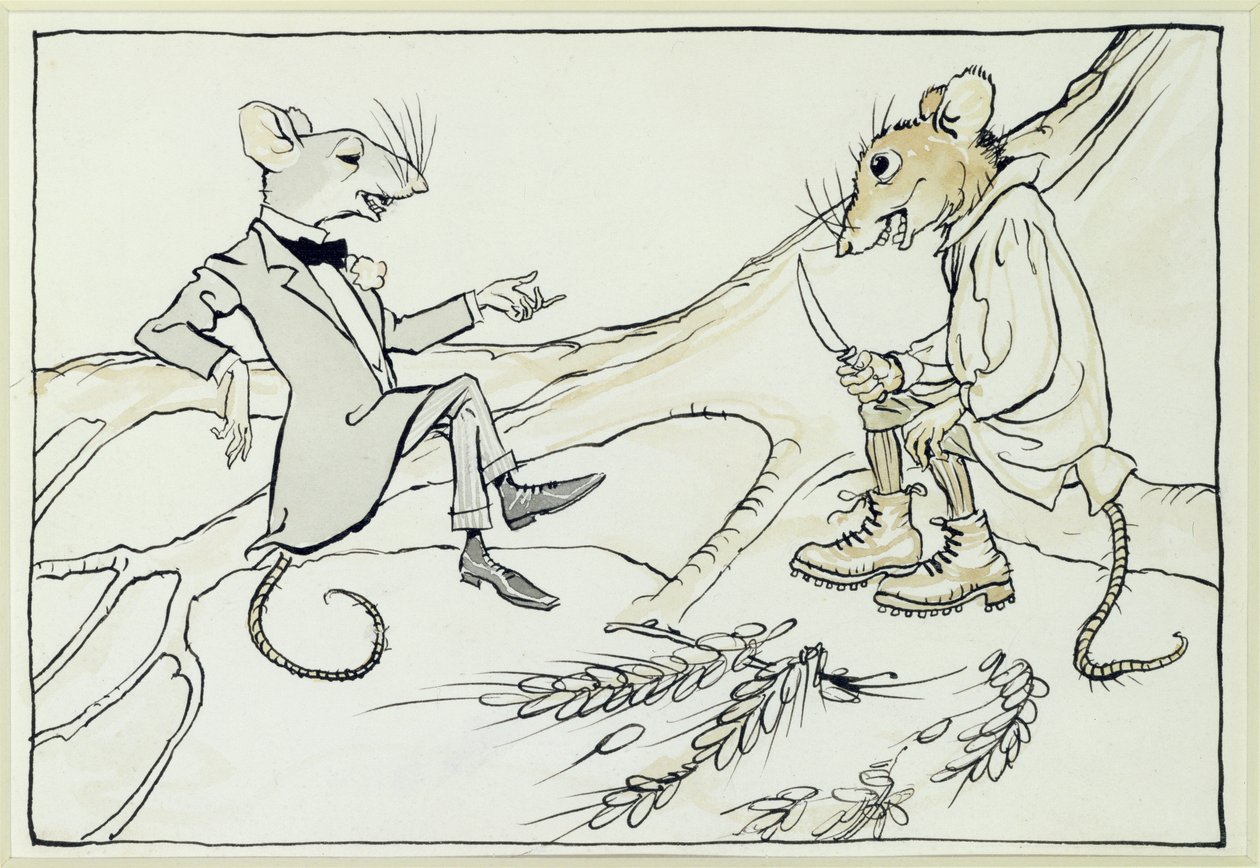
Aesop’s The Town Mouse and the Country Mouse is a childhood story known the world over. Seemingly simple, yet layered with meaning the more we study it. The story is about two mice who try each other’s worlds. The town mouse has a life filled with excitement, while the country mouse is rooted in simplicity and safety. But beneath the surface of this story lies a dynamic most of us recognise too well. The tension between stepping into the unpredictable space of relationships and retreating to safety and security.
Looking closer, the fable is more than a contrast between town life and country life. It becomes a map of our inner landscape, the shifting emotional terrain we move through. Sometimes we are the town mouse, brave, open, unprotected, willing to grow, willing to take part in the feast, even though we know a cat could claw at the door in any moment. And sometimes, we slip back into country mouse mode, seeking calm, returning to old routines or low-risk patterns that do not demand much from us.
Both modes can serve us, but what’s fascinating is the movement between them. The oscillation that shapes how we relate, love, grow, and protect ourselves. In retreat, we dream of the banquet; in the danger of the banquet, we long to return to the quiet fields. This inner tug-of-war is a deeply human rhythm that lies in the heart of relationships.
Aesop’s fable offers us a new perspective on how we navigate intimacy and discomfort, how every step forward carries its own unique threshold. Every trial in the “town” carries forth its own significant hero’s journey. Beyond that, Sufi wisdom reminds us that not all growth happens through effort. Sometimes it arrives quietly, in moments when we let go, trust, and simply allow life to unfold.
“Yesterday I was clever, so I wanted to change the world. Today I am wise, so I am changing myself.” — Rumi
Town-Mouse Mode
When we enter town-mouse mode in our relationships, we step into a world that feels pulsating, unpredictable, and alive. This is the domain where we take emotional risks and truly engage, the moments when we choose closeness over caution. Just like the country mouse arriving in the town, we taste the banquet: the intimacy, the excitement, the possibility. Everything feels richer, more charge, almost electric.
But the banquet is not without shadows.
In the fable, the feast is interrupted again and again by the cat clawing at the door. For the country mouse, it is a shock; for the town mouse, it is simply part of everyday life. This is what happens when we open ourselves to closeness: the “cat” appears. It might be the fear of rejection, the fear of being seen, old wounds haunting us through new encounters, or the simple realisation that all connection involves risk.
And just when the mice have caught their breath, convinced the danger is over, the dog storms in. In relationships, this is the next level of trial: the argument we did not see coming, the misunderstanding that shakes us, the collision of needs we were not ready to acknowledge. We think we have resolved one fear, only to discover a deeper one at the next threshold.
Here the connection to Joesph Campbell’s hero’s journey becomes clear. Town-mouse mode is a series of thresholds: first the cat, then the dog, each obstacle pressing us to grow beyond who we were. We descend into the unknown, encounter the parts of ourselves we would rather avoid, and finally emerge, if we stay long enough, changed.
Growth rarely happens in the quiet fields of our habitual patterns. It happens here, in the intensity of the town, at the banquet table, in the moments that unsettle us, in the noise and unpredictability that emotional risk brings. It happens when we remain seated at the table, even as we hear claws against the door.
But town-mouse mode is not a place to live. The same intensity that drives our development can also exhaust us. Even heroes return to their villages. When fears grow too sharp or the stakes too high, we slide back toward country-mouse mode, to the quiet fields and gentler rhythms, where we can regain balance before the next journey.
“Opportunities to find deeper powers within ourselves come when life seems most challenging.” — The Power of Myth, Joseph Campbell
Country-Mouse Mode
If town-mouse mode is the place where we grow, country-mouse mode is the place where we recover enough for that growth to become meaningful. It is the domain of retreat and recalibration, our inner landscape of quiet predictability, where nothing claws at the door and nothing demands more than we have to give.
In the fable, the country mouse returns home after the terrors of the feast. The landscape is simple but comforting: safe, familiar, controllable. Our inner country mouse offers the same refuge, a return to ourselves, to routines and places that feel manageable when contact with others has stretched us too far.
But the food never tastes quite the same after the banquet. Once we have experienced the richness of emotional closeness, the intimacy, the excitement, the experience of being seen, our comfort zone becomes both a refuge and a limitation. Safe, yes, but no longer nourishing.
This is the paradox of retreat. We withdraw because we need safety, rest because we are tired, ground ourselves again because the last “cat” or “dog” took more energy than we expected. But if we stay too long, we also stagnate. Country-mouse mode provides security, but no development. It is a pause in the story, necessary, restorative, but still a pause. We avoid conflict, avoid challenge, avoid exposure; and in doing so, we also avoid transformation.
Retreat, however, is not a failure. It is part of the rhythm. Psychologically, this is the restorative phase, the moment when the nervous system calms after relational intensity. Solitude, structure, and predictability give the heart space to process. Here, reflection happens. Here, integration happens. Here, meaning settles into place.
Country-mouse mode is the place where we catch our breath, but it is not the place where we stay forever.
“There is a voice that doesn’t use words. Listen.” — Rumi
The Cycle Between Growth and Retreat
One of the more subtle truths in The Town Mouse and the Country Mouse is that the story never truly ends. There is no final victory, no clear rest, no moral that closes the door. Instead, the fable ends in motion, a back-and-forth pendulum between two ways of living. That rhythm mirrors the inner cycle most of us move through in our relationships.
We enter town-mouse mode when we feel brave enough, or hungry enough, to step into deeper engagement. We open our hearts. We face challenges. We risk being seen. We sit down at the table, aware of the dangers that follow.
But that intensity is not sustainable. The banquet demands a great deal. Emotional availability, vulnerability, presence, all of these are powerful states, and they consume energy. Sooner or later, a fear becomes too sharp, a challenge too heavy, or the noise of connection simply overwhelming.
That is when we slide back into country-mouse mode. Retreat allows us to gather the parts that scattered during the last trial. We rest. We recalibrate.
And then, just as in the fable, something calls us back. Loneliness, curiosity, desire, or the simple realisation that we have outgrown the quiet fields that once sustained us. We move toward the banquet again, toward the next threshold that may make us more whole.
One thing I have learned is that not everything in relationships needs to be named or fixed. Sometimes contradictions can be allowed to exist, showing us something about ourselves without demanding immediate repair. The cycle is not a problem. It is part of being human.
Engagement→ Exposure→ Challenge→ Adaptation→ Withdrawal→ Integration→ Readiness.
Psychologically, it is the dance between expansion and contraction, between activation and rest, between the sympathetic system’s pull toward connection and the parasympathetic system’s stillness in solitude. In mythological terms, it is the hero’s journey repeating itself, not one great story, but many small ones.
In the mice’s metaphor, the lesson is simple: we need both worlds. We live in both worlds. And we grow by learning the art of moving between them.
“The only way to make sense out of change is to plunge into it, move with it, and join the dance.” — Alan Wilson Watts
The Sufi Path of Letting Go and Finding Peace
If town-mouse mode stands for engagement, challenge, and the heroic climb toward growth, the Sufi perspective offers a quieter current running beneath it all. Sufism speaks of dissolving the self, surrendering to the greater ocean, and finding peace not by conquering obstacles, but by releasing resistance to them.
In the world of the fable, this perspective appears in the stillest moments of town-mouse mode, the pause before the next wave hits. These are the brief, suspended moments when we know the “cat” may come or the “dog” may burst in, yet we still find an inner calm that does not depend on external safety.
It is the place where striving ceases and presence begins.
Sufi wisdom teaches us that even in the midst of relational intensity, when emotions are high, vulnerabilities exposed, and trials arise without warning, there is a way to remain grounded. Not by controlling every threat, but by remembering that the self we believe is under attack is only a drop in a much larger ocean.
Even in the town, we can carry the stillness of the countryside within us.
Here, the Sufi path and the hero’s journey intersect. At first glance they seem opposed, one is about overcoming, the other about surrendering, but in reality they reflect different moments in the same cycle. The hero’s journey is needed when the cat claws at the door; then we rise and meet what comes. The Sufi path is needed in the spaces in between; then we release fear, soften the grip of the ego, turn our hearts toward one another, and allow the divine rhythm to carry us forward.
Infused with Sufi sensitivity, town-mouse mode becomes more balanced. Instead of tensing ourselves against every danger, we cultivate an inner spaciousness. Challenges come and go, and return, but our identity does not need to be tied to each one. We do not have to be the frightened mouse pressed against the wall. We can be the drop that remembers the ocean.
This inner letting go transforms town-mouse mode from a panicked survival state into a grounded, conscious form of engagement. Growth continues, but it is softened by wisdom. The feast is still enticing, the dangers still real, but the heart is steadier.
In the town, we encounter trials. In the Sufi state, we remember that we do not need to control them. That insight allows us to move through relationships with more grace, more courage, and, quietly, a deeper acceptance of their ever-shifting rhythm.
“Wherever you turn, there is the face of God.” — Qur’an (2:115)
Balancing the Mice Within
The beauty of The Town Mouse and the Country Mouse lies in the fact that the story never asks us to choose one way of living over the other. Instead, it reveals something quieter and more honest: we carry both mice within us, and both have their place.
Town-mouse mode calls us into engagement. It draws us toward deeper connection, greater vulnerability, richer experiences, the kind of growth that only comes when we dare to live with a measure of uncertainty. This is where life feels alive, where the banquet is set, where our hearts are open and every challenge becomes a small hero’s journey.
Country-mouse mode brings us home. It receives us when the banquet becomes overwhelming and offers a place to rest, breathe, and feel safe. It reminds us that retreat is not weakness but a necessary exhale, a return to the familiar where we integrate what we have learned and recover our strength.
Between these modes lies the human rhythm.
We expand and contract.
We attach and withdraw.
We feast and recover.
We dream of the town and tend the quiet meadow.
When we introduce the Sufi perspective into this cycle, the picture deepens. Beneath the tug-of-war, beneath the risks and the periods of rest, beneath heroism and hesitation, there is a stillness we can carry everywhere. In the noise of the town, we can remember the ocean within us. In the countryside, we can carry the memory of the banquet.
In the end, it is not about becoming only a town mouse or only a country mouse. It is about honouring the dance between them, knowing when to engage, when to retreat, when to strive and when to surrender. Wisdom does not lie in choosing one way of life over the other, but in learning to move gently between them.
“Out beyond ideas of wrongdoing and rightdoing, there is a field. I’ll meet you there.” — Rumi
